
THE EXTENDED HISTORY
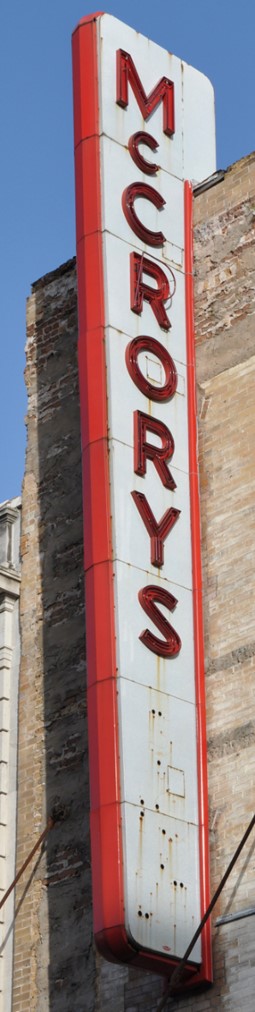
At its height, McCrory’s operated 1,300 stores under its own name and as TG&Y, McLellan (merged in 1958), H. L. Green, Silvers, G.C. Murphy, J.J. Newberry and Otasco, which it had acquired through the years. McCrory’s parent Rapid-American also owned Lerner Stores and National Shirt (acquired by McCrory’s in 1960).
Meshulam Riklis purchased McCrory in 1960 and merged it with the rival H.L.Green Co. and moved its headquarters to Springettsbury Township, York County, Pennsylvania, in 1963. At the time it was the fourth largest retailer in the United States. Riklis controlled McCrory’s through the Rapid-American holding company, which was managed by Samuel Neaman. Riklis’ famed sleight of hand, shifting assets between notable brand name successful companies and holding companies is best exemplified by his handling of McCrory Stores, driving the brand name into bankruptcy while keeping the assets. Among the retailers controlled by McCrory’s at the time were Best & Co., Lerner Shops, and S. Klein.
The company continued to thrive and grow during the 1960s and 70’s. McCrory Stores purchased the 439 unit J.J. Newberry Company in 1972. It operated Newberry as a separate division and continued to open stores under the Newberry banner. On January 1, 1981, McCrory purchased the S.H. Kress & Co. chain from Genesco. The 66 store chain, once a fierce rival, was a natural fit for the variety store chain.
McCrory purchased the Oklahoma-based TG&Y Discount store chain in 1985. This proved to be a difficult transition for the company as the discount chain was not a natural fit for McCrory. Many of the stores were beyond the typical 10-15K Sq. Ft. footprint that the company operated in and the merchandise mix was very different.
The TG&Y stores were not profitable and drained McCrory of valuable assets. Many of the TG&Y stores were converted to the Bargain Time banner that McCrory operated and were closed as the 1980s came to an end.
In 1987, McCrory Stores purchased the 76 remaining Kresge and Jupiter stores from the K Mart Corporation which had long given up on the variety stores division, reuniting the companies. All stores were converted to the McCrory banner. In 1989, McCrory Stores purchased the GC Murphy Co. from Ames Stores. The sale included the remaining GC Murphy Stores and Bargain World Stores as well.
In 1989, 1,300 stores were operated by the McCrory company. However, as the decade turned, its fortunes decreased, and by 1992 it filed for bankruptcy. The changing retail landscape including the migrating of shoppers from the inner cities to the influx of superstores such as Target and Wal-Mart sealed the fate of the once mighty Five And Ten. Several rounds of store closures followed, with one of the biggest coming in 1997 when McCrory’s shuttered 300 of its last 460 stores. The company also converted some stores to their Dollar Zone format of dollar store, but these closed in early 2002. In December 2001, McCrory Stores announced the remaining McCrory’s,[6] TG&Y, G. C. Murphy and J.J. Newberry stores it was operating would begin liquidating and in February 2002 the company ceased operation.
Source: Wikipedia
The Durban Family had a supply business that supplied Hook Drug Stores from their Northeastern Ohio warehouse and became friends with the founding family. In honor of Hook’s Drugs, we decided to created a site talking about this pioneering company.
Hook’s Drug Stores
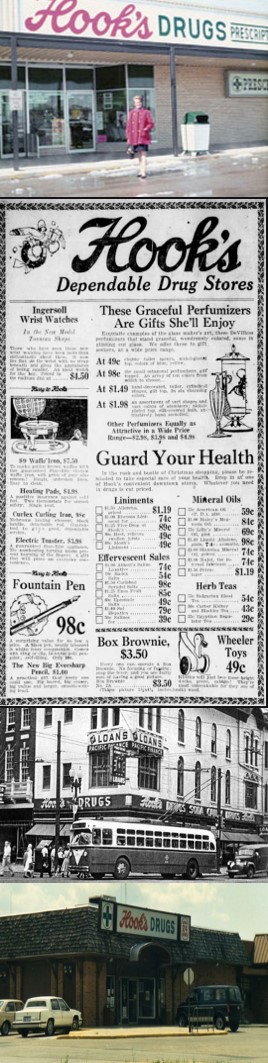
In October 1900, pharmacist John A. Hook opened the first Hook’s Drug Store in an Indianapolis German community at the corner of South East and Prospect Streets. A second location opened at the corner of New Jersey and East Washington Streets and Hook added Edward F. Roesch as a partner. By 1912, the chain had expanded to twelve stores. Many of Hook’s interwar drug stores were designed by Kurt Vonnegut Sr. of Vonnegut & Bohn. Roesch became president of the company in 1943 upon Hook’s death. In 1956, following Roesch’s death in a traffic accident, John Hook’s son, August F. “Bud” Hook, assumed leadership of the company. The chain added 150 new stores between 1946 and 1972.
In 1985, The Kroger Company outbid Rite Aid, which had attempted a hostile takeover, and acquired the Hook’s chain. Kroger divested itself of Hook’s a year later, however, and Hook’s became a division of the privately held Hook’s-SupeRx.
Hook’s-SupeRx acquired the New England-based Brooks Pharmacy chain in 1988. Hooks-SupeRx stores traded under three different names – Hook’s Drug and SupeRx in the Midwest and Brooks Pharmacy in New England. Hook’s-SupeRx was acquired by Revco in 1994. Revco was subsequently acquired by CVS in 1997. Many former Hook’s locations are now CVS Pharmacies
A restored 19th-century Hook’s drug store stands at the Indiana State Fairgrounds, and is a popular attraction at the annual Indiana State Fair. It was originally built in 1849 and has been restored with authentic 19th century cabinets.
Source: Wikipedia
The Hook’s Drugs Museum (Indiana State Fairgrounds)
In 1966, The Company opened the Hook’s Historical Drug Store and Pharmacy Museum at the Indiana State Fairgrounds as their corporate contribution to the Governor’s request for Indiana based companies to fund special initiatives celebrating Hoosier history and commemorating the state’s sesquicentennial.
The pharmacy cabinets, originally from a pharmacy in Cambridge City, feature reverse-glass painting technique. Several of the advertising art panels above the cabinets are still original, but some had to be restored.
The pharmacy cabinets were built in Cincinnati in the mid 1800’s and shipped to Cambridge City by horse & wagon. Copies of the original bills of lading are on display in the museum.
The back bar at the soda fountain is from Sunman, IN, and the pink Lippincott soda fountain ca.1877 was rescued from use as a planter, restored, and put back into use in the museum.
The cabinets in the store section of the museum are the original cabinets that were installed in the first Hook’s store in 1900. This first Hook’s store, then called the John Hook store, was located in Nashville, IN. They were also displayed in the old State Museum on Alabama Street as part of their Main Street Exhibit, and then moved to their currentl location in the museum in 2004.
The building the museum is currently housed in was never an operating drugstore. At one time it was the Better Babies Building and used to judge infants during the State Fair. The Board of Health was also housed in the building at one time. The classroom section (formerly Bud Hook’s office) and the Red Cross facility were added on in the 1970’s.
1202 E 38th St, Indianapolis, IN 46205 (317) 924-1503
Future Programming: We are exploring creating Hook’s Drugs concepts in the near future.